

Building better infrared sensors
Proof-of-concept device outperformed commercial indium gallium arsenide photodiodes in responsivity.
Detecting infrared light is critical in an enormous range of technologies, from remote controls to autofocus systems to self-driving cars and virtual reality headsets. That means there would be major benefits from improving the efficiency of infrared sensors, such as photodiodes. Researchers at Aalto University have developed a new type of infrared photodiode that is 35 % more responsive at 1.55 micrometers, the key wavelength for telecommunications, compared to other germanium-based components. Importantly, this new device can be manufactured using current production techniques, making it highly practical for adoption.
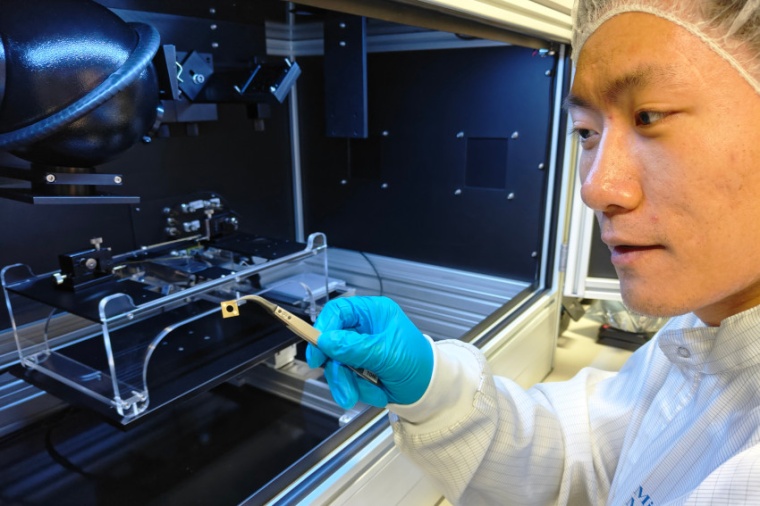
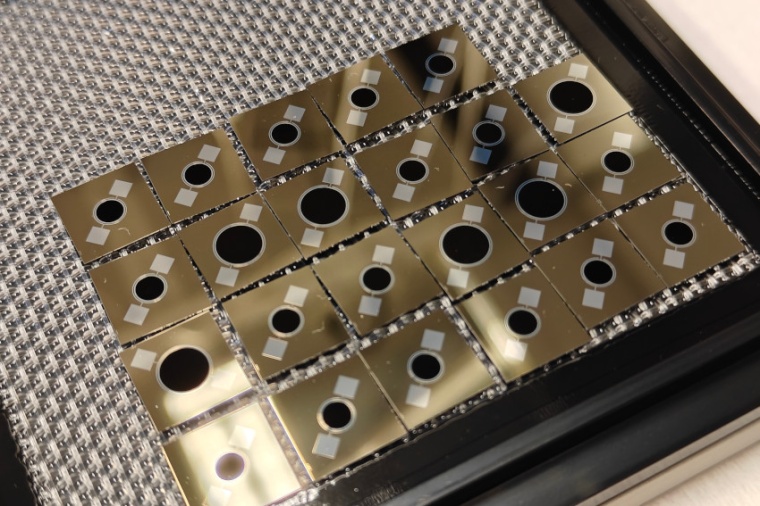
“It took us eight years from the idea to proof-of-concept,” says Hele Savin from Aalto University. The basic idea is to make the photodiodes using germanium instead of indium gallium arsenide. Germanium photodiodes are cheaper and already fully compatible with the semiconductor manufacturing process – but so far, germanium photodiodes have performed poorly in terms of capturing infrared light. Savin’s team managed to make germanium photodiodes that capture nearly all the infrared light that hits them.
“The high performance was made possible by combining several novel approaches: eliminating optical losses using surface nanostructures and minimizing electrical losses in two different ways,” explains Hanchen Liu, the doctoral researcher who built the proof-of-concept device. The team’s tests showed that their proof-of-concept photodiode outperformed not only existing germanium photodiodes but also commercial indium gallium arsenide photodiodes in responsivity. The new technology captures infrared photons very efficiently and works well across a wide range of wavelengths. The new photodiodes can be readily fabricated by existing manufacturing facilities, and the researchers expect that they can be directly integrated into many technologies.
“The timing couldn’t be better. So many fields nowadays rely on sensing infrared radiation that the technology has become part of our everyday lives,” says Savin. Savin and the rest of the team are keen to see how their technology will affect existing applications and to discover what new applications become possible with the improved sensitivity. (Source: Aalto U.)
Link: Dept. of Electronics and Nanoengineering, Aalto University, Espoo, Finland


most read

IMTS 2026: AI, Automation, and Investment Are Driving the Next Phase of Growth in Manufacturing
IMTS 2026 drew more than 91,000 visitors. AI, robotics, and automation were the hallmarks of the trade show and reflect the transformation of U.S. manufacturing.

Solid-State Transformers for AI Data Centers
As part of a strategic partnership, Siemens and Reinhausen are developing a solid-state transformer for AI data centers with an 800-volt DC system.

Siemens Consolidates Its Automation Business into a New Unit Called Automation
Rainer Brehm, who previously served as COO of the automation business and CTO of Digital Industries, was appointed president of the new unit.
The photonics industry is growing significantly again: New orders rise by 17 percent
The German photonics industry saw significant growth in the first half of 2026. Semiconductors, defense, aviation, and quantum technologies are the main drivers of this growth.
Cognex Acquires RealSense
With this acquisition, Cognex is expanding its portfolio to include 3D depth sensing technology for robotics and physical AI. The market is expected to grow significantly by 2030.