

Fraunhofer expands Apecs’ possibilities
As part of the pilot line, the Fraunhofer Institute for Applied Solid State Physics will continue to expand its semiconductor research infrastructure.
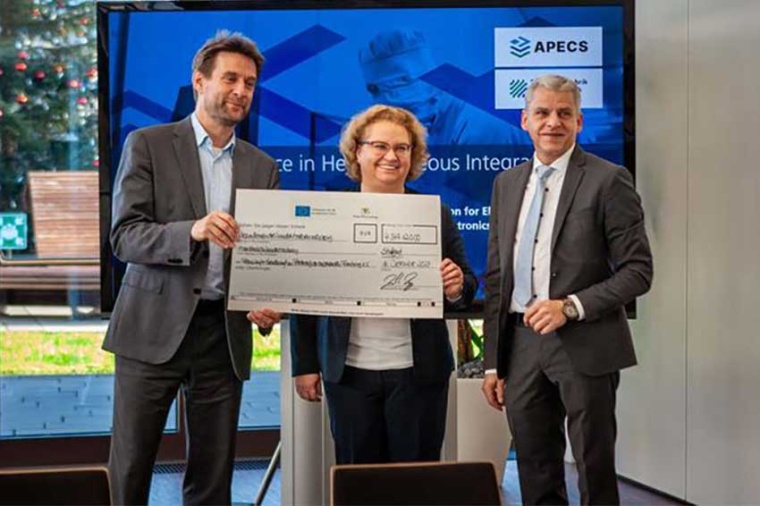
Fraunhofer IAF is expanding its technological capabilities in the field of III-V compound semiconductors, making a valuable contribution to the development of the Advanced Packaging and Heterogeneous Integration for Electronic Components and Systems “Apecs” pilot line within the framework of the EU Chips Act. The Baden-Württemberg Ministry of Economic Affairs, Labor and Tourism is contributing 4.35 million euros to the funding. On 16 December 2024, State Secretary for Economic Affairs Dr Patrick Rapp symbolically handed over a cheque for the funding amount to the institute’s directors. Apecs will further expand the research and development infrastructure across Europe, integrating core technologies, including CMOS and III-V for RF, photonics, and sensors.
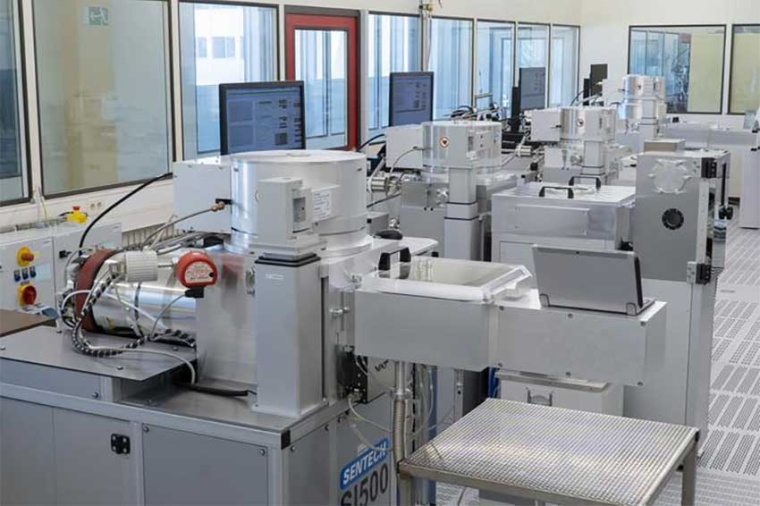
Apecs is an important component of the EU Chips Act to drive chiplet innovation and increase research and manufacturing capacity for semiconductors in Europe. The institutes cooperating in the FMD are working closely with other European partners to set up the pilot line and are thus making a significant contribution to strengthening Europe’s technological resilience and thus also increasing global competitiveness in the semiconductor industry.
The pilot line will provide large industrial companies as well as small and medium-sized enterprises (SMEs) and start-ups with low-threshold access to cutting-edge technologies and ensure secure, resilient semiconductor value chains. Apecs is co-funded by Chips Joint Undertaking and by national funding from Austria, Belgium, Finland, France, Germany, Greece, Portugal and Spain under the Chips for Europe initiative. The total funding for the Apecs pilot line amounts to EUR 730 million over four and a half years.
Apecs focuses on the scalable industrial transfer of newly developed innovations in the field of heterointegration, in particular the use of new chiplet technologies, thus building a bridge to application-oriented research. It goes beyond conventional system-in-package (SiP) methods and aims to deliver robust and trustworthy heterogeneous systems that significantly increase the innovative capacity of the European semiconductor industry.
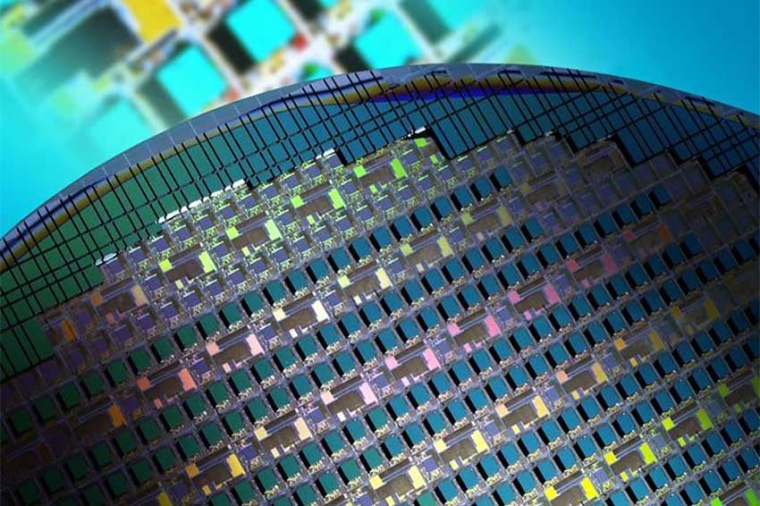
The increasing performance and cost requirements for electronic components mean that conventional semiconductor chips are increasingly reaching their technological limits. The processing of large integrated circuits, as required for comprehensive functionalities, causes high costs, as individual defects have an extremely strong impact on the yield of a single wafer. In addition, chemical and mechanical incompatibilities between different materials and layer structures mean that only a limited number of different technologies can be implemented on a single wafer.
A novel solution for efficiently increasing system functionality is the electrical or optical connection of individual small components (so-called chiplets) on a common substrate (interposer). With the chiplet approach, the individual technologies can each undergo the optimum epitaxy and processing for them and then form a highly functional, flexible and efficient chip-sized system through low-loss integration. This modularization also increases scalability, simplifies chip design and shortens the time to market for innovations.
Link: APECS Pilot Line, Fraunhofer Institute for Photonic Microsystems IPMS, Dresden, Germany
Company
Fraunhofer Institute for Applied Solid State Physics IAFTullastraße 72
79108 Freiburg
Germany


most read
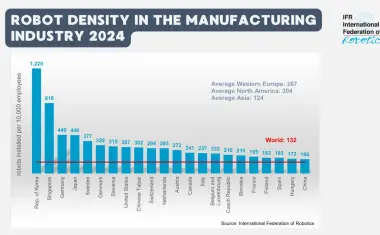
Global robot density: Western Europe leads ahead of North America and Asia
In the EU-27, the robot density is 231, which is above the global average of 132.

Solid-State Transformers for AI Data Centers
As part of a strategic partnership, Siemens and Reinhausen are developing a solid-state transformer for AI data centers with an 800-volt DC system.

Siemens Consolidates Its Automation Business into a New Unit Called Automation
Rainer Brehm, who previously served as COO of the automation business and CTO of Digital Industries, was appointed president of the new unit.

Discontinuation and End of Support
Neurocheck will end the product life cycle of its Neurocheck 6.1 image processing software on December 31, 2026.

Spectaris Strengthens Expertise in Digital Regulation and AI
Since August 1, Maximilian Kunze has been serving as a consultant for the German Industry Association for Optics, Photonics, Analytical and Medical Technology.