

New educational initiative for the German chip industry
Securing skilled workers for the chip industry – with this goal in mind, the nationwide flagship project “Skilled workers for microelectronics: skills4chips” launched on November 1, 2024.
More chips “made in Europe”: The European Union aims to double the share of semiconductors produced in Europe from 10% to 20% by 2030 and to intensify regional semiconductor production through the European Chips Act. Expanding these production capacities requires qualified personnel. This is where skills4chips comes in: The project is establishing the “Microtec Academy” as a national educational hub for microelectronics and microsystem technology. The BMBF is providing €12 million in funding over four years.
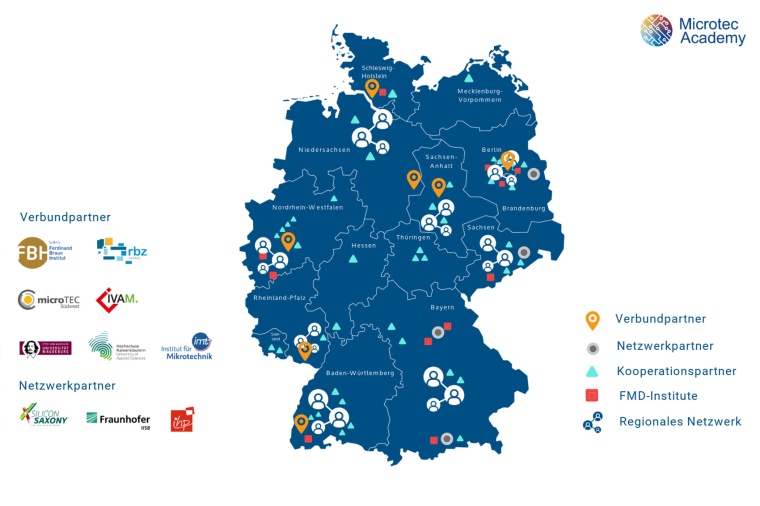
The skills4chips consortium, led by the Berlin Ferdinand-Braun-Institut, Leibniz Institute for High-Frequency Technology, brings extensive experience in training and education within high-tech fields. This expertise is built on results from two previous BMBF-funded projects, “BM = x³” and “Microelectronics Academy”. Numerous proven initiatives from regional clusters can be continued and enriched with new offerings, such as partial qualifications or specific programs for career changers.
In the long term, the "Microtec Academy” aims to increase the quality and quantity of education and training in microelectronics on all levels, from career orientation, vocational training, and university studies to reskilling and upskilling. Special attention will be given to reaching new target groups, tailoring educational programs to demand, and training vocational teachers and trainers. New digital solutions, such as a virtual technology lab, will enable innovative training measures, supporting flexible learning and offering a wide range of formats, from online courses and hybrid models to hands-on courses that combine theory and practice.
The project consortium, led by FBH, comprises six additional partners, each contributing specific expertise: the regional vocational training center of Steinburg, the Institute of Microtechnology at the Technische Universität Braunschweig, the Department of Computer Science and Microsystems Technology at the University of Applied Sciences Kaiserslautern, Otto von Guericke University Magdeburg, Microtec Südwest, and the IVAM Microtechnology Network. Additional cooperation and network partners from all over Germany, such as the Forschungsfabrik Mikroelektronik Deutschland (FMD) and Silicon Saxony, are supporting the flagship project to advance workforce development in microelectronics and microsystem technology.
Company
Ferdinand-Braun-Institut, Leibniz-Institut für HöchstfrequenztechnikGustav-Kirchhoff-Str. 4
12489 Berlin
Germany



most read

Spectaris Strengthens Expertise in Digital Regulation and AI
Since August 1, Maximilian Kunze has been serving as a consultant for the German Industry Association for Optics, Photonics, Analytical and Medical Technology.

Discontinuation and End of Support
Neurocheck will end the product life cycle of its Neurocheck 6.1 image processing software on December 31, 2026.
Mitutoyo Open House Day 2026: Focus on Precision Measurement Technology
This free event is aimed at professionals in manufacturing and quality assurance who would like to learn about the latest developments in precision measurement technology.

Solid-State Transformers for AI Data Centers
As part of a strategic partnership, Siemens and Reinhausen are developing a solid-state transformer for AI data centers with an 800-volt DC system.

The Imaging Source Strengthens Its Sales Team
The company has appointed Stefan Brendjes as its new Sales Manager for Southern Germany.