

Photonics West for the win
Companies receive Prism Awards and Startup Challenge prizes at Photonics West, San Francisco.
On the evening of February 1st, SPIE recognized the top-rated new optics and photonics products with the industry-focused Prism Awards. The gala evening, held during Photonics West, also marked the Prism Awards’ 15th anniversary with a champagne toast, a timeline gallery of past winners, and a video showcasing a decade and a half of Prism highlights.


Each year, the SPIE Prism Awards reflect the rapidly growing trajectory, exciting latest developments, and rich technical innovations across photonics and photonics-enabled industries. This year, the annual ceremony honored a range of established and emerging companies applying innovative and creative solutions to critical problems in areas such as augmented and virtual reality, sensors, lasers, quantum technology, and biomedical optical solutions. For consideration this year, SPIE received 76 applications from 19 countries. The 2023 winning companies and products in the eight categories are:
- AR VR MR: TriLite Technologies, Trixel 3
- Biomedical: Philophos, KUOS-O100
- Cameras and Imaging: Metalenz, PolarEyes
- Lasers: Kyocera SLD Laser, LaserLight LiFi system
- Quantum Tech: QuiX Quantum, 20-mode quantum photonic processor
- Sensors: Ocean Insight, SpeedSorter
- Software: Dotphoton, Jetraw
- Test and Measurement: Precitec Optronik, Flying Spot Scanner (FSS 310)
Finalists and winners were selected by a panel of international judges who leveraged their knowledge and acumen from across the technology commercialization and funding sectors. The distinguished judges’ roster included the FDA’s Zane Arp, iFocus’ Adi Diner, AXA-XL’s Simi George, MKS Instruments’ Marc D. Himel, Coherent’s Qiongying Hu, Chromacity’s Shahida Imani, Teledyne Princeton Instruments’ Jason McClure, Technology Scotland’s Alison McLeod, Tesseract Health’s Nishant Mohan, Engender Technologies’ Cather Simpson, Ceres Technology Advisors’ Linda Smith, Toptica’s Mark Tolbert, and Nanovation’s Ferechteh Teherani.
The evening before, Swave Photonics – with their Holographic eXtended Reality chips based on proprietary diffractive photonics technology – was announced the winner of the $10,000 top prize at the 13th annual SPIE Startup Challenge.
Qart Medical, utilizing biophotonics and data for 3D analysis of sperm cells during IVF, received $5,000 for second place. PhosPrint came in third, winning $2,500, with their novel bioprinting technology that repairs in vivo human tissue during surgery. All cash prizes are provided by SPIE Startup Challenge founding partner Jenoptik.
The SPIE Startup Challenge, a pitch competition held annually by SPIE, the international society for optics and photonics, showcases new businesses, products, and technologies that address critical needs by utilizing photonics in the areas of healthcare and deep tech. This year’s finalists included innovations in medical diagnostics, medical imaging, food safety, and display technology.
Company
SPIEPO Box 10
Bellingham WA 98227-0010
US



most read

Solid-State Transformers for AI Data Centers
As part of a strategic partnership, Siemens and Reinhausen are developing a solid-state transformer for AI data centers with an 800-volt DC system.
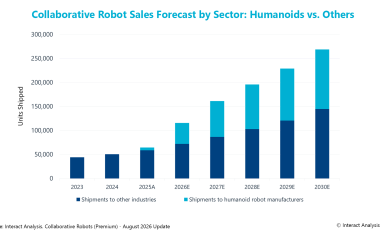
Humanoid robotics is driving demand for cobot arms and actuators
According to recent analyses, global production of humanoid robots exceeded the 20,000-unit mark in 2025 and is expected to more than triple in 2026.
Vision 2026 Breaks Exhibitor Record
About 500 exhibiting companies—about two-thirds of which are from abroad and about 30 percent of which are first-time exhibitors—are showcasing their products at the trade show.

Siemens Consolidates Its Automation Business into a New Unit Called Automation
Rainer Brehm, who previously served as COO of the automation business and CTO of Digital Industries, was appointed president of the new unit.
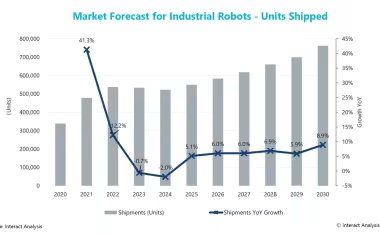
Forecast: Significant Growth in Industrial Robotics by 2030; Cobots Are Growing the Fastest
According to a recent analysis by Interact Analysis, global sales of industrial robots are expected to rise from about 550,000 units in 2025 to just over 760,000 units in 2030.