

PhotonicsViews issue 1/2022 is out
Issue 1/2022 – February / March – is online and has been mailed. It includes feature articles from Cailabs, Coherent, Hamamatsu Photonics, Ingeneric, iPronics, Joya Team, Solmates, and more companies and institutions. On the cover: Shenzhen JPT Opto-Electronics.
Cover story is “Comparing the sheet metal welding performance of different lasers”. Further title stories are “Silicon Photonics – Programmable chips for 5G applications”, and “Beam Shaping – Microfluidic chip sealing using femtosecond lasers”.


The printed copies are now on its way to your mailboxes – read all articles ‘online open’ at the WileyOnlineLibrary.com – or browse the e-paper here on WileyIndustryNews.com.
Pitch your story for issue 2/2022 April / May – out in time for Laser World of Photonics and the AKL’22 Congress – now and submit your manuscript until February 28. Book your ads until March 21 and get a half-page company profile for free.
You want the printed issue in your mailbox? Please find the form for paid or qualified subscriptions for download below:
Company
Wiley-VCH GmbHBoschstraße 12
69469 Weinheim
Germany



most read

ZVEI Calls for Swift Protection of Critical Power Infrastructure
The association has issued a statement in response to the recent attempted attacks on substations in Brandenburg and North Rhine-Westphalia and warns of the consequences for Germany's energy security.

Solid-State Transformers for AI Data Centers
As part of a strategic partnership, Siemens and Reinhausen are developing a solid-state transformer for AI data centers with an 800-volt DC system.

Schaeffler bundles Defense and New Space activities under new CEO
Celia Pelaz takes over the position of CEO Defence & New Space at Schaeffler on October 1, 2026 and becomes Chairwoman of the Management Board of Stech Defence GmbH.
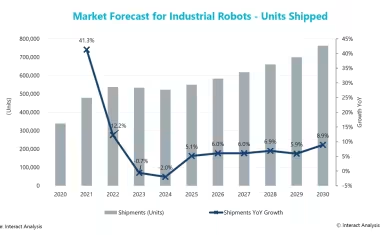
Forecast: Significant Growth in Industrial Robotics by 2030; Cobots Are Growing the Fastest
According to a recent analysis by Interact Analysis, global sales of industrial robots are expected to rise from about 550,000 units in 2025 to just over 760,000 units in 2030.

European machine vision expects slight recovery and growth in 2026
According to the VDMA Machine Vision department, sales are expected to increase by around 3%, following a decline of 2% in 2025.