

“Revolutionizing augmented reality”
Infineon’s new MEMS scanner for eyeglasses and head-up displays.
What if your everyday eyeglasses became the next media for augmented reality applications? What if every car could display valuable data on the whole windshield to securely guide you through the traffic? The new MEMS scanner solution from Infineon Technologies, comprising a MEMS mirror and MEMS driver, allows completely new product designs. Its miniature size and low power consumption are the basis for making augmented reality (AR) solutions more widely available for consumer applications such as wearables and for automotive head-up displays.
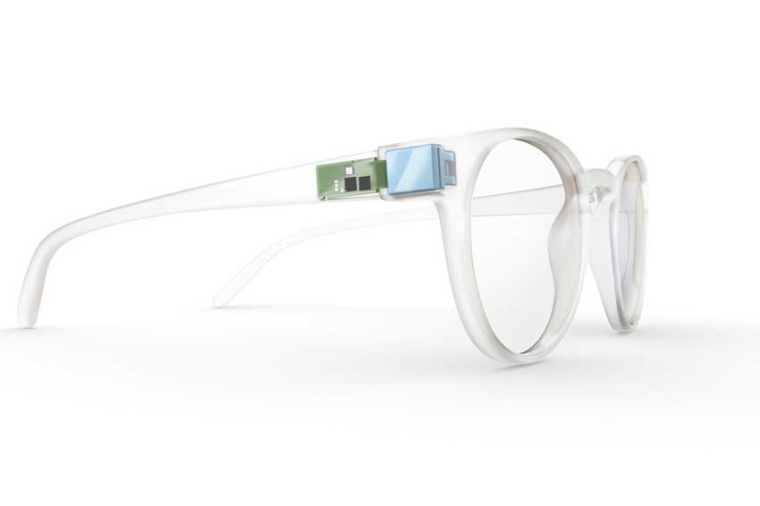
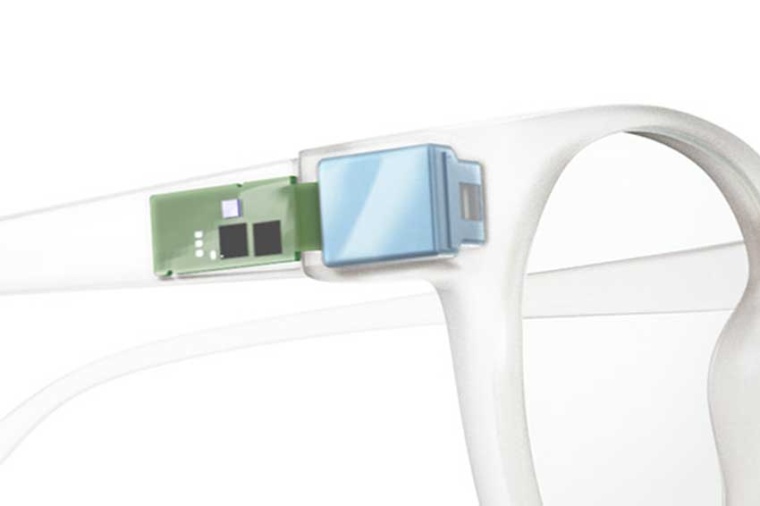
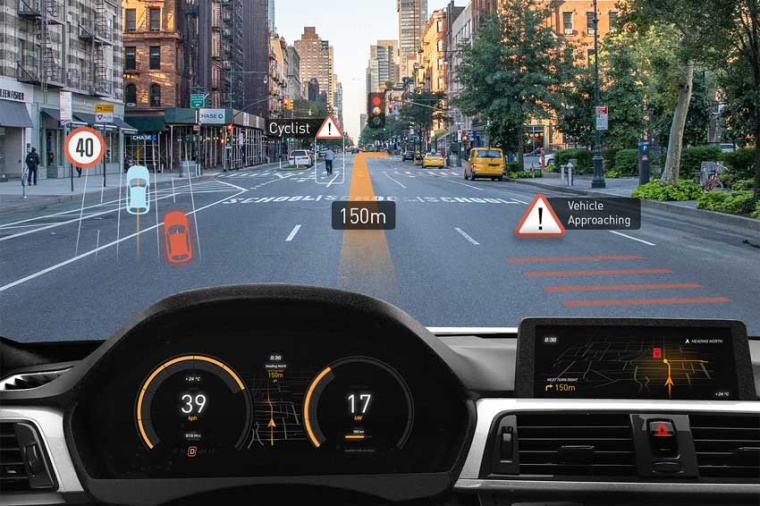
“Augmented reality solutions enrich real environments with valuable digital data and help people to move around more conveniently and safely in daily life, for business and leisure activities, but especially on the street,” said Charles Chan, head of Infineon’s automotive MEMS product line. “Maps, infotainment or messages projected on everyday glasses guide people to the nearest supermarket or shared car park around the corner. Overlaying valuable information, from route navigation to driver assistance systems, over the car’s complete windshield, instead of just over a small area in front of the driver, is a major step ahead for improving driving safety and convenience.”
Infineon’s MEMS scanner chipset features an innovative tilting mirror which lays the foundation for a new generation of laser beam scanner (LBS) projectors. Compared to alternative system designs and competitive MEMS scanner solutions, Infineon’s new chipset stands out in terms of performance, size, energy consumption and competitive system costs.
A major challenge when developing AR-HUDs is integrating the system into the dashboard, due to space restrictions. Conventional HUD systems can be more than thirty liters in optical volume, yet still offer only a very modest field of view. By contrast, laser beam scanners based on Infineon’s MEMS scanner chipsets enable HUD systems with minimum optical volume, so they can be integrated into even the smallest dashboard. Easy integration together with a competitive bill of material also bring AR-HUDs with a large field of view to small cars and compact classes.
Digital information in constant view with AR smart glasses
The Infineon MEMS scanner chipset enables the design of an AR micro-projector which is light in weight and can be aesthetically integrated into all-day-wear eyeglasses and sports glasses. Thanks to the chipset’s low power consumption, small batteries can easily be integrated into the frame, allowing the glasses to be worn conveniently throughout the day without the need to frequently recharge the batteries.
To advance the development of AR smart glasses’ systems for the consumer market, Infineon is collaborating with TriLite Technologies, a Vienna-based start-up. While Infineon looks after the MEMS scanner chipset, TriLite is responsible for system integration and control algorithms that enhance the optical performance of the system. Both companies combine several years of research in optical MEMS and mass manufacturing capabilities. (Source: Infineon)
Company
TriLite Technologies GmbHFrankenberggasse 13
1040 Vienna
Austria

most read

ZVEI Calls for Swift Protection of Critical Power Infrastructure
The association has issued a statement in response to the recent attempted attacks on substations in Brandenburg and North Rhine-Westphalia and warns of the consequences for Germany's energy security.

European machine vision expects slight recovery and growth in 2026
According to the VDMA Machine Vision department, sales are expected to increase by around 3%, following a decline of 2% in 2025.
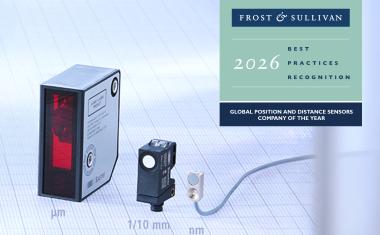
Baumer Honored as Company of the Year
Frost & Sullivan has named Baumer the 2026 Global Company of the Year in the Position and Distance Sensing category.
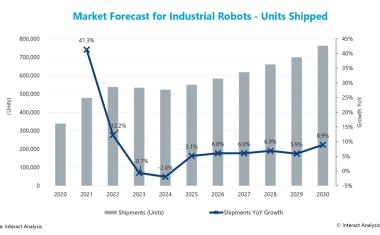
Forecast: Significant Growth in Industrial Robotics by 2030; Cobots Are Growing the Fastest
According to a recent analysis by Interact Analysis, global sales of industrial robots are expected to rise from about 550,000 units in 2025 to just over 760,000 units in 2030.

Siemens Consolidates Its Automation Business into a New Unit Called Automation
Rainer Brehm, who previously served as COO of the automation business and CTO of Digital Industries, was appointed president of the new unit.