

Fluence opens new facility in Poland
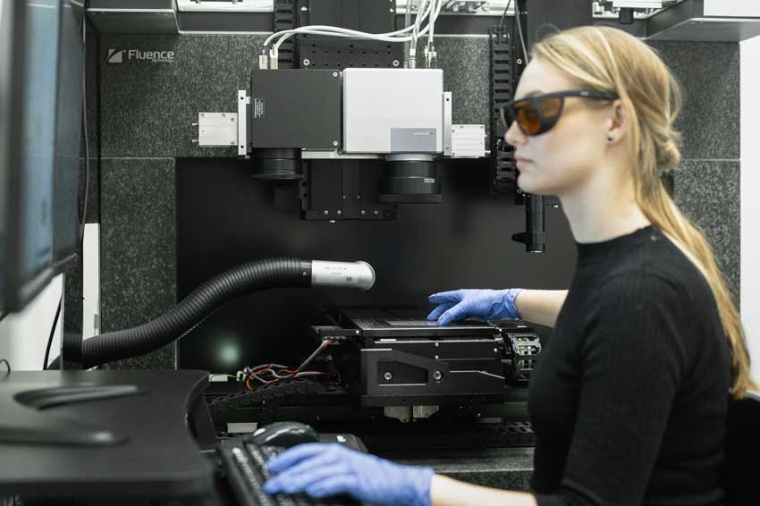
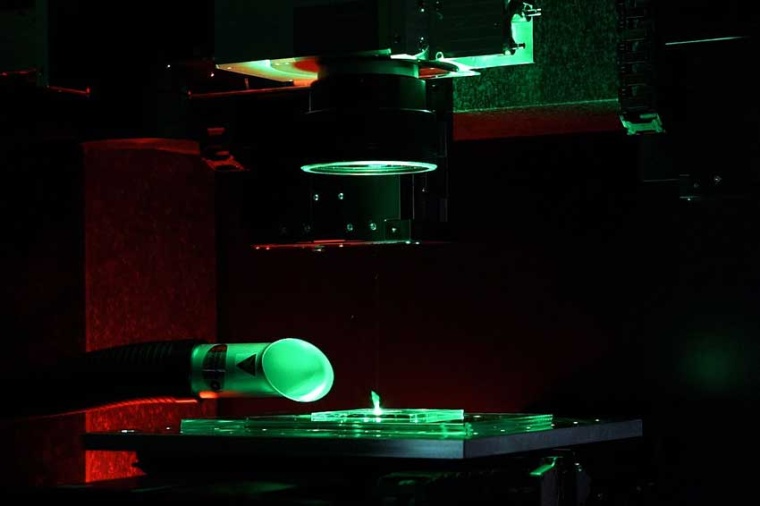
The new laboratory in Wrocław is equipped with a top-class, high-precision automated micromachining station based on high-power femtosecond lasers.
Intended to develop laser processes for future products and technologies that will forge new frontiers in micromachining for consumer electronics, medical devices, and other applications, the Ultrafast Laser Application Laboratory (ULAL) allows Fluence to test new processing strategies for industry, perform feasibility studies, and identify new applications.

“The new facility will give our customers the hands-on technical experience they need to solve complex laser micromachining challenges in cutting, microdrilling, marking, structuring, welding, scribing, and more,” said Bogusz Stępak, R&D director of laser microprocessing at Fluence.
The micromachining station is comprised of positioning stages, galvoscanners, and various fixed and beam-shaping optics. At the ULAL’s heart is Fluence’s Jasper 30 femtosecond fiber laser, which offers three wavelengths, pulse duration tuning from 230 fs to 10 ps, and different temporal pulse structures.
Covering micromachining at an average power of up to 30 W, with up to 20 MHz rep rates, the Jasper laser offers single pulse and burst mode for process enhancement. This enables splitting of the main pulse into two to thirty pulses, so each provides optimal laser fluence or energy accumulation desired in some applications. Separated by tens of nanoseconds, the pulses in burst mode interact with plasma and open up new possibilities for shaping surface morphology.
Partnerships with Scanlab, ACS Motion Control, and Direct Machining Control (DMC) allow for the machining of large samples with precise motion synchronization between scanner and linear stages. The ULAL has a Scanlab excelliSCAN galvoscanner, which offers exceptional beam direction stability and acceleration of 51,000 m/s2 to steer the laser beam around the sample. The galvoscanner works in tight synchronization with an ACS SPiiPlus motion controller as part of an XL SCAN system providing high-accuracy laser processing over a 400 × 600 mm area. Laser process machine control is handled by DMC software. The ULAL is the first and only facility on the continent where XL SCAN can be demonstrated together with a femtosecond laser. In addition, the laboratory has the ability to perform fast glass cutting thanks to partnerships with Holo/Or (using their DeepCleave module) and the Workshop of Photonics (WoP).
The ULAL targets laser micromachining applications such as cutting glass, polymer, metal (including titanium, wolfram, and tungsten) and hard materials like diamond and sapphire; microdrilling; surface structuring; surface functionalization; in-volume and surface marking; selective layer removal; semiconductor scribing; and transparent material welding.
The facility’s higher harmonic generation enables greater precision and improved surface finishes. Second harmonic generation (SHG) and third harmonic generation (THG) processes offer a small beam spot, strong light absorption, and minimal heat accumulation to cut heat-sensitive polymers and achieve smooth surfaces on different materials.
Company
Fluence sp. z o.o.ul. Kolejowa 5/7
01-217 Warsaw
Poland



most read
Otto wins IERA Award 2025
Rockwell's robot is an AMR solution that can transport heavy loads in factories and operate in robot fleets of over 100 units.
Qioptiq Photonics becomes Excelitas Germany
The renaming is part of the global consolidation of the Excelitas Group.

HMS Networks takes over Industrial Communications division from Molex
This strategic acquisition includes intellectual property in hardware and software, a product portfolio with network cards and software stacks, as well as customer relationships in the USA and Japan.
SEW-Eurodrive and TTTech Digital Solutions enter into partnership
The aim of the collaboration is to integrate SEW-Eurodrive's axis and drive systems into the Ubique automation platform.

ZVEI survey: Significant investments in industrial AI planned
A recent survey by the ZVEI shows that the manufacturing industry in Germany wants to invest significantly in industrial AI.